
AI Foreseeing Parkinson's Disease
In one sentence: Aiii uses computer vision and deep learning (OpenPose motion analysis) to assist early recognition and long-term tracking of Parkinson's disease —— simply record a video in the App to detect tremor and bradykinesia, and digitize MDS-UPDRS scoring and medication-response tracking (supportive reference, not a medical diagnosis).
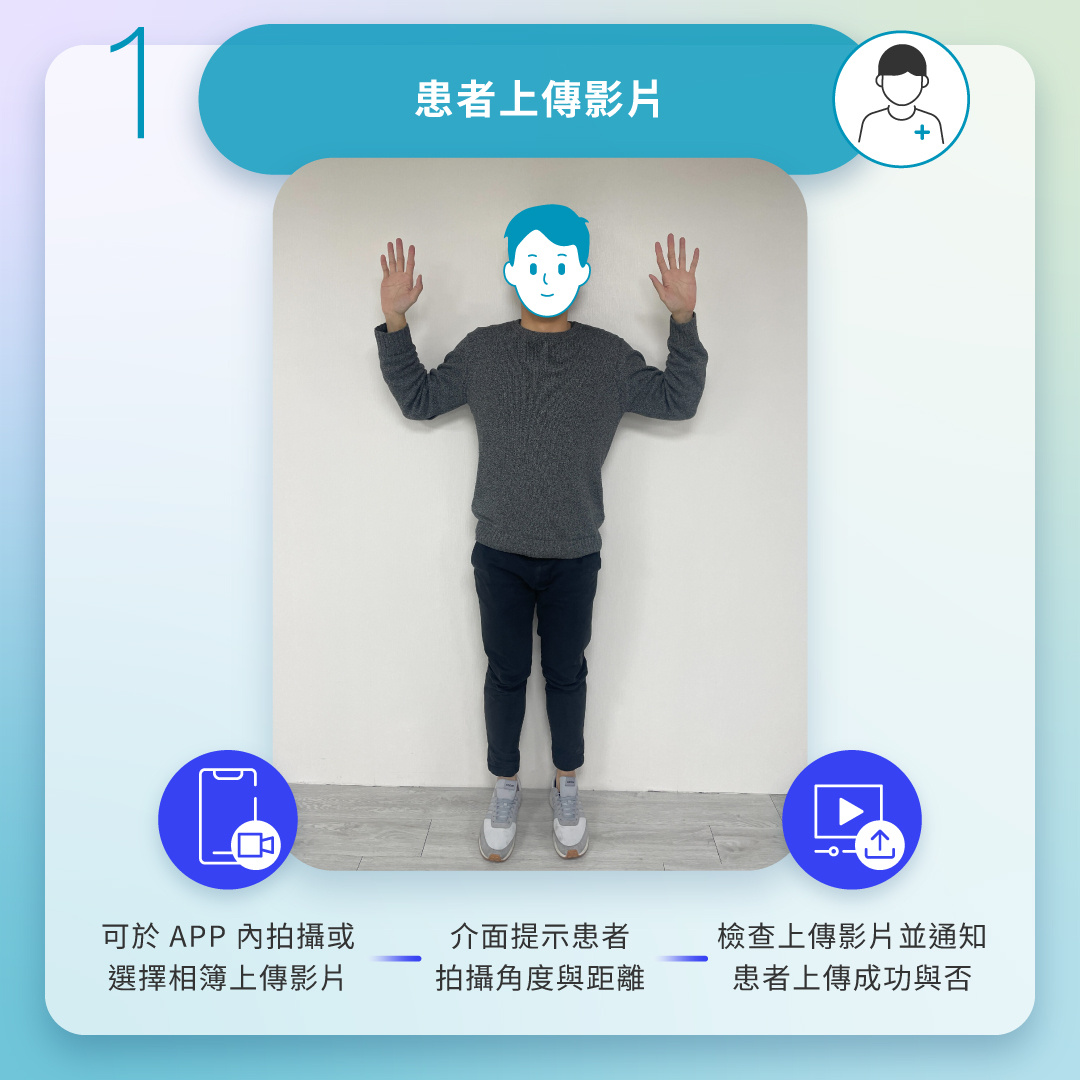
Step 1 Upload a Video
- Record within the App or select and upload a video from your photo library
- OpenPose detects in real time whether key body nodes deviate from the preset ranges; if a deviation is detected, the interface instantly prompts the correct way to adjust
- Checks the uploaded video and notifies the patient whether the upload was successful
Step 2 Integrated Clinical Assessment Platform
- Digitized UPDRS scoring system: integrates the MDS-UPDRS motor examination into a digital scoring interface
- Time-series comparison: presents a patient's historical assessment data to support longitudinal comparison
- Medication-response tracking: records ON/OFF state assessments to optimize medication-adjustment strategies

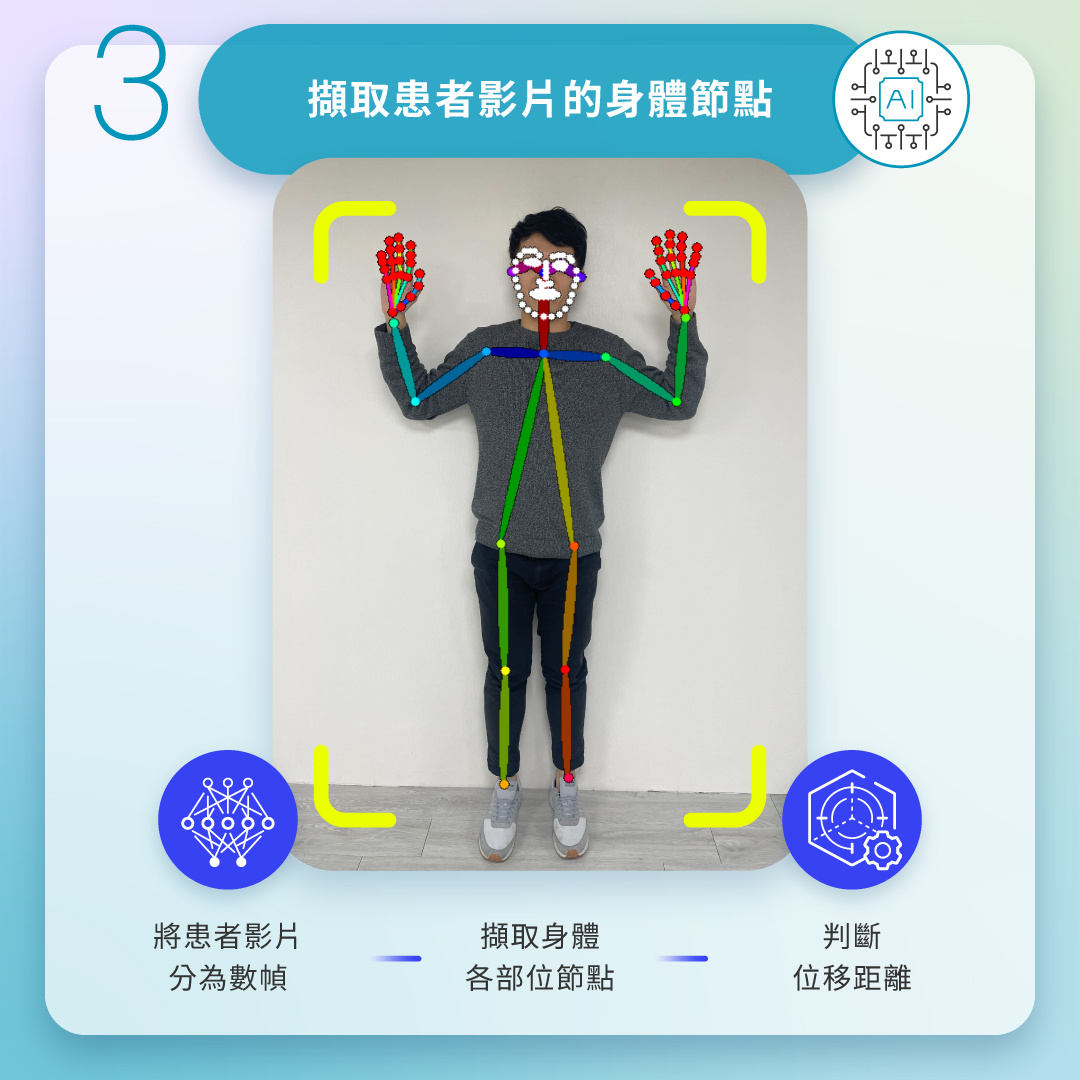
Step 3 Capture the Patient's Body Nodes
- Use OpenPose to extract key points
- Reduce data dimensionality: using OpenPose to extract the key points of the human body greatly reduces the amount of data to process, as only the coordinates of the key points in each frame need to be handled rather than the full image of every frame.
- Focus on motion features: OpenPose is specifically designed to extract human body key points, which is very useful for analyzing features such as body movement and posture. In Parkinson's detection, features such as tremor and bradykinesia are often expressed through limb movement, and using key points allows these movements to be captured more precisely.
- Enhance the model's generalization ability: through key points, the model can learn motion features that are unaffected by the background or other external factors, which helps improve the model's generalization to different scenarios.
- Organize features such as the coordinates, velocity, displacement distance and timing of each of the user's body nodes, and apply a Long Short-Term Memory (LSTM) model to predict the severity of the user's Parkinson's symptoms



Frequently Asked Questions
How does AI help with early recognition of Parkinson's disease?
Using computer vision and deep learning (OpenPose key-point detection), it analyzes motion features such as limb tremor and bradykinesia to assist earlier identification, giving patients a window of opportunity for treatment (not a medical diagnosis).
How do I use it? Do I need a wearable device?
No. Simply record or upload a video within the App, and the system uses OpenPose to detect in real time whether key body nodes deviate from the preset ranges.
Can it track disease progression and medication response?
Yes. It digitizes MDS-UPDRS motor scoring, performs time-series comparison of historical data, and records medication ON/OFF states to help optimize medication-adjustment strategies.
How is the privacy of personal health footage protected?
The system only captures the coordinates of human body key points rather than the full image, greatly reducing data dimensionality, and processes data on a privacy-first basis.
Will this replace a physician's diagnosis?
No. The AI is a supportive and long-term tracking tool; the final diagnosis and treatment are still determined by qualified medical professionals.
Contact US

-
Email|[email protected]
- Phone|02-55687660